Following the Yalta Conference, Germany was divided into two major regions. The Soviet Union occupied the eastern half of Germany while Great Britain, France, and the United States occupied the western half.
Which of the following statements is supported by the information above?
A. A communist government controlled Western Germany.
Incorrect. Western Germany was occupied by anti-communist governments.
B. A communist government controlled Eastern Germany.
Correct! The Soviet Union and its communist government occupied the eastern half of Eastern Germany.
C. A dictatorship was implemented in Western Germany.
Incorrect. Occupied by the United States, Great Britain, and France, Western Germany was not controlled by a dictatorship.
D. Individual rights were expanded in Eastern Germany.
Incorrect. Under communist control, individual rights were limited in Eastern Germany.
The phrase “iron curtain” was used in connection with what event?
A. The occupation of France by the Soviet Union
Incorrect. France was one of the Western allies and never occupied by the Soviet Union.
B. The censorship of ideas and free speech by Great Britain
Incorrect. Great Britain is a democratic nation and has supported a free press.
C. The division of Europe between the West and the Soviet Union that controlled Eastern European nations
Correct! The “iron curtain” was the barrier between Eastern and Western Europe—between communist nations occupied by the Soviet Union and democratic nations allied with the United States and Great Britain.
D. The U.S. strategy to contain communism in Vietnam
Incorrect. The U.S. strategy to prevent the spread of communism in Vietnam has been called the “domino effect” – if not contained, communism will spread from nation to nation like the falling of dominoes.
Why was the Berlin Airlift needed?
A. To transport needed supplies to West Berlin
Correct! With the Soviet blockade of West Berlin, Great Britain and the United States flew in supplies to provision the West Berliners.
B. To evacuate wounded soldiers from East Berlin
Incorrect. The Berlin Airlift was focused on provisioning the citizens of West Berlin during the Soviet blockade of their city.
C. To send East German refugees to other countries
Incorrect. The Berlin Airlift was focused on provisioning the citizens of West Berlin during the Soviet blockade of their city.
D. To provide supplies to all of West Germany
Incorrect. The Berlin Airlift was focused on provisioning the citizens of West Berlin during the Soviet blockade of their city.
Which of the following best describes the goal of Truman’s policy of “containment”?
A. Stop the spread of nuclear weapons.
Incorrect. Under the policy of “containment” the United States and Soviet Union stockpiled their arsenals of nuclear weapons.
B. Keep allies loyal to the United States.
Incorrect. “Containment” used the allies of the United States to prevent the spread of communism around the world.
C. Increase the spread of democratic ideas around the world.
Incorrect. The strategy of “Containment” tried to prevent the spread of communism around the world.
D. Prevent the spread of communism around the world.
Correct! The strategy of “Containment” tried to prevent the spread of communism around the world because it was seen as a threat to democratic values.
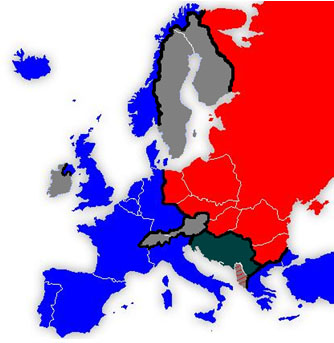
Which of the following best reflects the map above?
A. Differences between American and Soviet political systems
Correct! The Cold War was a non-violent clash of political systems between the democratic values of the United States and the communist ideas of the Soviet Union.
B. Destruction of the Berlin Wall
Incorrect. The destruction of the Berlin Wall accelerated the fall of the Soviet Union and brought an end to the Cold War.
C. Differences between German and Cuban weapons systems
Incorrect. Cuba was allied with the Soviet Union and presented a threat to the United States, especially during the Cuban Missile Crisis of 1963.
D. Development of the European Union
Incorrect. The European Union was formed after the fall of the Soviet Union as a way to create economic and political unity among the nations of Europe.