Which of the following statements most accurately describes the ancient cities of Harappa and Mohenjo-Daro?
A. Being some of the earliest human cities, they lacked advanced architecture.
Incorrect. While Harappa and Mohenjo-Daro were among the first human cities, they displayed very impressive architecture, from large homes and bathhouses to towering citadels that overlooked the city.
B. They were highly organized and planned urban environments.
Correct! As the aerial photo of Mohenjo-Daro shows, the Harappan people clearly were experts in urban planning and had a very clear vision of what the layout of their city was going to be.
C. Since the language of the Harappan civilizations has never been deciphered, historians know basically nothing about them.
Incorrect. While it is true that the Harappan language has not been deciphered, historians and archaeologists can still learn a great deal by studying artifacts, buildings, and other clues.
D. They were built around 2600 BCE when humans were still hunter-gatherers.
Incorrect. It is impossible for hunter-gatherer societies to build large, settled cities because hunter-gatherers are always on the move and producing just enough food to sustain a small group. Cities such as Mohenjo-Daro were made possible by the invention of farming.
Among the artifacts discovered in the ruins of Harappa and Mohenjo-Daro were small cubes which archaeologists determined were used for weights and measures. What might these tell us about Harappan society?
A. Harappan people were experts at cooking and measured ingredients precisely.
Incorrect. While this may be true, we don’t believe the weights and measures were used for cooking.
B. Without more information it is impossible to know what these weights and measures were used for.
Incorrect. Historians are relatively certain what these artifacts were used for.
C. The measurement of building materials for Harappan cities needed to be precise.
Incorrect. While this is true, it is unlikely that the small cubes were used to measure building materials.
D. The Harappan people were involved in trade and economic activity.
Correct! The weights and measures tell us that Harappan people made economic transactions and needed to know the amount of goods and money that were being exchanged.

What does this image suggest about Harappan social life?
A. Harappans used their craftsmanship to create toys for children.
Correct! Archaeologists believe these terracotta models were actually children’s toys.
B. The Harappan probably worshipped the bird.
Incorrect. Historians do not believe these small sculpture indicate anything about religious beliefs.
C. Only the wealthy could afford animals in Harappan culture.
Incorrect. While this may have been true, it is not a conclusion you can make based on the image.
D. The Harappan used animals and chariots in warfare.
Incorrect. It does not appear that these sculpture represent anything having to do with warfare.
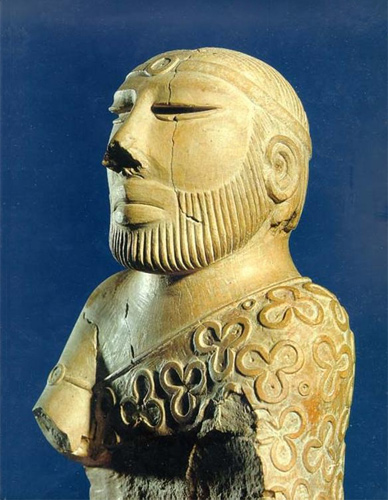
What conclusions can we draw about the man depicted in this Harappan statue?
A. Given the small size and poor craftsmanship, the man depicted in the statue was probably poor.
Incorrect. In fact, the quality of the craftsmanship is rather high to have survived for as long as it has.
B. The man was probably a servant.
Incorrect. The clothing and expression suggests someone of higher stature than a servant.
C. The man was probably a political ruler or religious figure.
Correct! The crown and clothing suggest someone of high status, and the rulers of early civilizations were typically priests or priest-kings of some kind.
D. The man is probably a merchant.
Incorrect. Good guess, but the pose and clothing suggest someone of very high stature in society, and merchants did not attain high status rank in society until much later in history.
What does the preponderance of wells, drains, and bath houses in Mohenjo-Daro suggest about Harappan society?
A. Water was one of the most valuable and rare resources for the Harappan.
Incorrect. While this may have been true, it is not a conclusion than can be drawn from the information given.
B. Water was an abundant resource in Harappan society.
Incorrect. While this may have been true, it is not a conclusion that can be drawn from the information given.
C. Cleanliness was important in the Harappan religion.
Incorrect. While this may have been true, there is no reason to make an inference about religion from the fact that there were many bath houses.
D. The Harappan placed a high value on sanitation and cleanliness.
Correct! Keeping their city well organized and clean was clearly important to the ancient Harappan.