In this lesson, you will be learning about prepositions. Whoa, what just happened? Did a couple of prepositions just fly by without you noticing them? Yes, the words “In” and “about” in the first sentence are both prepositions, and they tell you two things: what you are going to learn and when you are going to learn it. However, before we get too far into the lesson, watch this video as a way of warming up to the subject.
Source: Schoolhouse Rock Prepositions, WritingClass, YouTube
Prepositions get their name from the Latin word praeponere, which means to “put in front” or “pre-position.” This makes sense because prepositions almost always appear at the beginning of prepositional phrases, something you’ll learn more about later on. The point is that prepositions tell us more about other words and add new information to sentences.
One popular trick in understanding and locating prepositions is to use the phrase “anywhere a mouse can go.” When you think about it, as silly as it sounds, this trick can tell you tons about the work of prepositions. Think about it. Where can a mouse go?
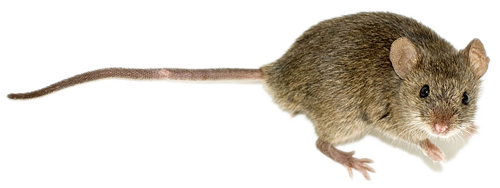
Source: House Mouse (Mus musculus),
George Shuklin, Wikimedia Commons
It can go
- out the door,
- down a hole,
- into the house, and
- across the floor.
All of these places use a preposition to tell us where this little critter is or was going. Of course, prepositions have other uses, too. They can also tell us when something is happening.
Now, let’s see how prepositions can describe events in time.
Tom came in after the game.
The preposition after introduces information that describes when Tom arrived. Here are several more examples of prepositions that tell us when something happened.
- after I turned the corner
- before he heard me coming
- during the time it took me to turn around
In the exercise below, choose the best preposition from each drop-down menu to make up a story about a mouse in a house. Think about where a mouse goes and about the words before and after the preposition. The first few prepositions, which display in red, have been chosen for you.

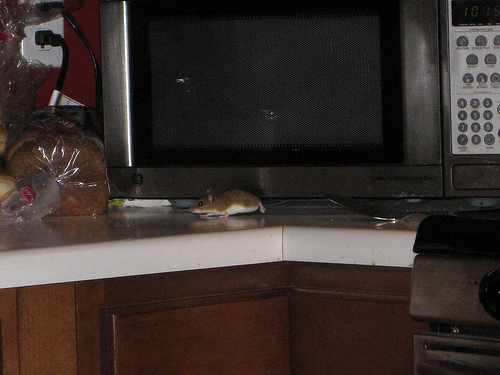
Source: A Mouse in the House, Ben W, Flickr
As you can see, you can use prepositions to help describe all sorts of things. In fact, we use many prepositions to describe the contents of our messages, and many of the prepositions fall into two categories: place and time.
Prepositions of place tell where something happens, while prepositions of time tell when something happens. To help you identify these two types, review the lists below.
| “Place” prepositions that tell where something happened or is happening | |||
|---|---|---|---|
| in | on | below | above |
| near | under | behind | over |
| onto | beside | into | across |
| around | among | between | opposite |
| “Time” prepositions that tell when something happened or is happening | |||
|---|---|---|---|
| at | in | during | before |
| after | since | by | for |
Of course, we use other prepositions, too.
| except | without | like | as | around |
As you can see, there are many prepositions. Together, they help writers and speakers be more precise. In fact, without them, we would be hard-pressed to be understood. Imagine trying to tell your friend about something that happened at a game without using prepositions. It might look something like this example:
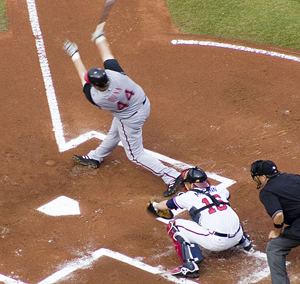
Source: Cincinnati Red's outfielder Adam Dunn strikes out swinging to Atlanta Braves pitcher John Smoltz. Braves' catcher Brian McCann catches the pitch behind the plate., Lomn, Wikimedia
I saw the game yesterday. You should have seen it. The game was tied. Bad shape. It was now or never. Things looked pretty bleak. Todd struck out. Carl hit a homer. The other team couldn’t match our points. We won.
Of course, you wouldn’t go around talking (or writing) like this because it would be hard for anyone to understand what you were trying to say. You would also end up writing or speaking in short, choppy sentences. Without prepositions such as to, at, after, and during, your message might leave people wondering what you meant.
Chances are you use little powerhouse prepositions every day, but did you ever stop to think what makes them so powerful? It’s quite simple actually. They help us communicate with one another by describing the where and when, and sometimes the why and how, of messages.
Now, let’s go back to our confusing and choppy, preposition-starved message about the game. Use the prepositions to, in, after, and during to make the message clearer. Choose the best preposition from each drop-down menu to complete each sentence.
While you were completing the task above, did you happen to notice anything about the prepositions? Did you notice that they don’t like being by themselves? They need a lot of help from other words. In fact, prepositions get help—whether they like it or not—from nouns and pronouns called objects of prepositions, which you will read about in the next section.