Making Connections Between Texts
of Different Periods in History

Source: English people, Thomas Gun, Wikimedia
Another strategy that is useful is called “chunking.” When you chunk a text, you divide it into manageable sections and then read it again to gain more understanding. When you’re reading several texts and need to make comparisons, chunking is helpful because it creates a framework for each reading that can be used for comparisons and contrasts.
The directions for chunking text follow. Read them carefully so that you can use this strategy in the next activity.
Chunking a Text
- Determine where the introduction ends. Place a sticky note or draw a line across the page where the introduction ends. Questions to ask as you do this: Does the introduction end after the first paragraph, or are there several paragraphs in the introduction? How did you determine this?
- Determine where the conclusion begins. Place a sticky note or draw a line across the page where the conclusion begins. Questions to ask: Does the conclusion begin with the last paragraph, or are there several concluding paragraphs? How did you determine this?
- Discuss in groups or as a whole class why lines were drawn where they were in the text. Focus more on the thinking and reasoning behind your responses rather than trying to agree on the location of introduction and conclusion. (This step is optional if you are working on this lesson by yourself.)
- Divide the remaining paragraphs into sections by identifying what each section is about and by marking the text. Note where the author’s writing shifts in purpose, moving from one idea to another.
Now print the texts for the two activities that follow and then chunk them according to the directions above. Download a printable version of either text by using the link at the end of the reading. When you finish the first exercise, check your understanding to see how I chunked the text.
This excerpt is from a speech by U.S. Representative Horace Davis of California. It was delivered to the House of Representatives in Washington, D.C. in 1878. Davis’s speech led to the Chinese Exclusion Act of 1882 that barred Chinese people from immigrating to the United States.
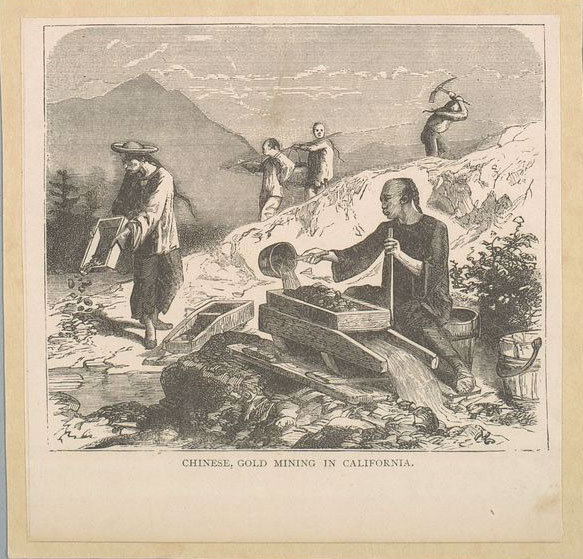
Source: “Gold Mining in California,” Betmann and Corbis, University of California History Digital Archives
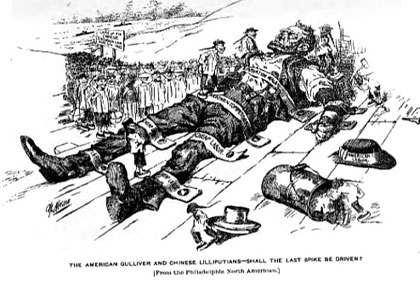
Source: “The American Gulliver,” Philadelphia North American
The question of Chinese immigration is regarded by the people of California with an intense interest of what citizens on this side of the continent have but little conception. Twenty-eight years ago the pioneer Chinaman was welcomed with an eager curiosity, but with no foresight of the eventful consequences of his coming. Today, he is found in every village, in every mining camp, utterly an alien in the body-politic, and like some foreign substance in the human body, breeding fever and unrest till that system is relieved of its unwelcome presence. On the question of restricting his coming, our community is almost a unit; except a few men who profit by his cheap labor, the sentiment of the people is nearly unanimous. It includes both political parties, all nationalities, all classes of the community.
The anti-Chinese societies include every nationality; both political parties have repeatedly expressed the same views on this subject in legislative enactments as well as in political platforms. . . .
In the city of San Francisco, my own home, this opposition is most keenly felt, as the body of Chinese is larger there than at any other point in the United States; and many thousands of unemployed men say with great bitterness that but for their presence, work and bread would be plenty. For months past life and property have been threatened by this agitation, and to the wisdom of Congress we appeal to grant us that quiet and relief which our own Legislature has no power to give us.
Believing as I do, that the indifference of Congress on this subject has arisen mainly from a lack of knowledge concerning the Chinese, I will ask your candid attention while I describe their social condition in California. I will then show you, first, that the presence of so large a foreign body unable or unwilling to assimilate to our ways renders them a dangerous element to society and a grave peril to the State; second, that their presence is a menace to free labor; and lastly, that the experience of other countries in dealing with this class of immigrants gives us no reason to hope for any change in these respects. . . .
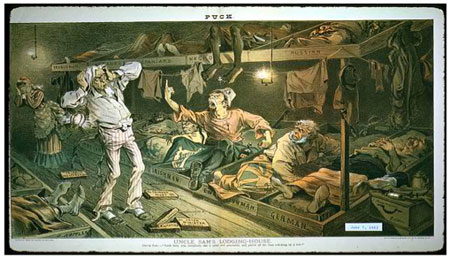
Source: “Uncle Sam’s Lodging House,” Puck, Michigan State University
This persistent fondness with which the Chinamen cling to their nationality and separate themselves from other men, their incapacity to change their ways and adapt themselves to their surroundings—this alone renders them most undesirable immigrants, and it has been and is today, always and everywhere, their most marked trait.
They are the most conservative of men. Arriving at their present form of civilization many centuries ago, their development seems to have been arrested and ages of uniformity have fixed the type. And this rigidly crystallized national sentiment has nothing in sympathy with the social and political thought of a free people. . . .
Over against this picture I hardly need to draw that of the European immigrant. He comes to this country to settle for life. He brings with him his wife and children. He adopts our language, mingles with our people, and becomes an American. And even if with the first generation the love of the fatherland strives with his affection for his new home, the next generation become American citizens. But with the Chinese the so-called immigration is simply an ebb and flow from the shores of Asia of a tide of men hopelessly foreign, without wish or intention to make this their home. . . .
Download a printable version of this speech.
Sample Response:
The question of Chinese immigration is regarded by the people of California with an intense interest of what citizens on this side of the continent have but little conception. Twenty-eight years ago the pioneer Chinaman was welcomed with an eager curiosity, but with no foresight of the eventful consequences of his coming. Today, he is found in every village, in every mining camp, utterly an alien in the body-politic, and like some foreign substance in the human body, breeding fever and unrest till that system is relieved of its unwelcome presence. On the question of restricting his coming, our community is almost a unit; except a few men who profit by his cheap labor, the sentiment of the people is nearly unanimous. It includes both political parties, all nationalities, all classes of the community.
The anti-Chinese societies include every nationality; both political parties have repeatedly expressed the same views on this subject in legislative enactments as well as in political platforms. . .
The introduction suggests that California is overrun with Chinese immigrants. The speaker says that people are unanimous in their desire to restrict Chinese immigration.
In the city of San Francisco, my own home, this opposition is most keenly felt, as the body of Chinese is larger there than at any other point in the United States; and many thousands of unemployed men say with great bitterness that but for their presence, work and bread would be plenty. For months past life and property have been threatened by this agitation, and to the wisdom of Congress we appeal to grant us that quiet and relief which our own Legislature has no power to give us.
San Francisco has the largest population of Chinese immigrants, and they are taking jobs away.
Believing as I do, that the indifference of Congress on this subject has arisen mainly from a lack of knowledge concerning the Chinese, I will ask your candid attention while I describe their social condition in California. I will then show you, first, that the presence of so large a foreign body unable or unwilling to assimilate to our ways renders them a dangerous element to society and a grave peril to the State; second, that their presence is a menace to free labor; and lastly, that the experience of other countries in dealing with this class of immigrants gives us no reason to hope for any change in these respects. . . .
This persistent fondness with which the Chinamen cling to their nationality and separate themselves from other men, their incapacity to change their ways and adapt themselves to their surroundings—this alone renders them most undesirable immigrants, and it has been and is today, always and everywhere, their most marked trait.
They are the most conservative of men. Arriving at their present form of civilization many centuries ago, their development seems to have been arrested and ages of uniformity have fixed the type. And this rigidly crystallized national sentiment has nothing in sympathy with the social and political thought of a free people. . . .
The speaker will take on the task of describing the Chinese to a Congress he believes does not understand the problem. He says that the Chinese do not want to become Americans. They don't want to adapt to new ways.
He contrasts the Chinese with Europeans whom he says come to this country planning to be American.
Over against this picture I hardly need to draw that of the European immigrant. He comes to this country to settle for life. He brings with him his wife and children. He adopts our language, mingles with our people, and becomes an American. And even if with the first generation the love of the fatherland strives with his affection for his new home, the next generation become American citizens. But with the Chinese the so-called immigration is simply an ebb and flow from the shores of Asia of a tide of men hopelessly foreign, without wish or intention to make this their home. . . .
As you can see from the speech and the cartoon, the debate about immigration isn’t new. Now read the second text, which is an editorial from the New York Times. It tackles the current immigration debate. Chunk the article as you read through it. You may need to read it more than once to do this. When you have finished, check your understanding to see how I chunked the text.
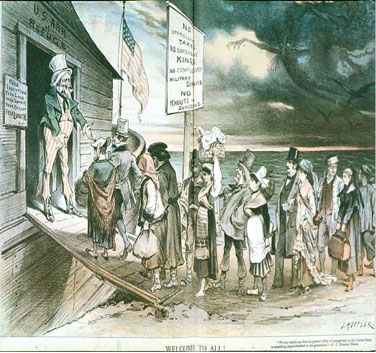
Source: “Welcome to all!,” J. Keppler, Puck, Library of Congress
Immigration: It’s Time
President Obama keeps saying he is serious about fixing immigration. You can expect him to say it again at the National Hispanic Prayer Breakfast in Washington on Friday morning. He will likely say it again next week, if his twice-postponed meeting with Congressional leaders to discuss immigration reform finally takes place.
This profusion of promises has not led to any results. Inaction and the passing of time have only increased the frustration of those who have been counting on Mr. Obama to deliver something on immigration reform—a plan, a timetable, the outlines of a bill.
Mr. Obama needs to break the stalemate on immigration. And he needs to do it soon.
He owes it to the Hispanic voters whose overwhelming support helped push him into the White House, and to the undocumented immigrants whose lives have been made miserable under a cruel, ill-conceived enforcement crusade that was concocted in the last administration and survives into this one.
The president can’t do it alone. Democrats in Congress, especially in the House, need to stop being bullied by anti-immigrant bullies. They need to be joined by moderate Republicans, most importantly by Senator John McCain, who must once again defy his party’s zealots to support sensible immigration reform.
Of the many messes President George W. Bush left behind, the failure to fix immigration is one of the few he ever expressed any regret about. There is a lot to regret.
There was wide agreement—in the country and in Washington—on the elements of sensible, comprehensive reform: tighter border and workplace enforcement; a path to assimilation instead of deportation for 12 million illegal immigrants; and an improved future flow of workers and families. It all fell apart in the heat of right-wing politics.
Now it’s Mr. Obama’s turn to lead the country to a different result. No one is expecting a huge bill to pass in a matter of weeks or even months. But there are things he can do right now that will underscore his seriousness.
It boils down to a simple question: If you accept legalization for the undocumented as desirable and inevitable, then why continue to put them through hell?
As they wait for a legalization bill, they are suffering under unjust laws, corrupt policing and a detention and deportation system that routinely suppresses their rights. American citizens who are Hispanic, and are all too frequently victims of racially-driven sweeps, are also suffering. Mr. Obama and his Homeland Security secretary, Janet Napolitano, must do much more to curb those excesses.
Republicans must also do their part. Will they knuckle under once again to the anti-amnesty posses, the Minutemen and nativist dead-enders? Or will they help revive and pass a realistic and desperately needed reform—teaming up with an engaged president and a re-energized John McCain?
The American people have been far out front of the politicians on this issue, overwhelmingly supporting comprehensive reform. Washington can still catch up. There’s still time. And the country is waiting.
Download a printable version of this article.
Sample Response:
Immigration: It’s Time
President Obama keeps saying he is serious about fixing immigration. You can expect him to say it again at the National Hispanic Prayer Breakfast in Washington on Friday morning. He will likely say it again next week, if his twice-postponed meeting with Congressional leaders to discuss immigration reform finally takes place.
When the writer repeats the word say, he is implying that the President is saying rather than taking action or doing something about immigration issues.
This profusion of promises has not led to any results. Inaction and the passing of time have only increased the frustration of those who have been counting on Mr. Obama to deliver something on immigration reform—a plan, a timetable, the outlines of a bill.
Mr. Obama needs to break the stalemate on immigration. And he needs to do it soon.
This section suggests that President Obama has made promises that he hasn’t kept, and people are impatient.
He owes it to the Hispanic voters whose overwhelming support helped push him into the White House, and to the undocumented immigrants whose lives have been made miserable under a cruel, ill-conceived enforcement crusade that was concocted in the last administration and survives into this one.
This section says that President Obama owes his election to Hispanic voters and illegal immigrants whose lives are miserable because of government policies.
The president can’t do it alone. Democrats in Congress, especially in the House, need to stop being bullied by anti-immigrant bullies. They need to be joined by moderate Republicans, most importantly by Senator John McCain, who must once again defy his party’s zealots to support sensible immigration reform.
Democrats must be joined by Republicans such as Senator McCain to support immigration reform.
Of the many messes President George W. Bush left behind, the failure to fix immigration is one of the few he ever expressed any regret about. There is a lot to regret.
President Bush said that he regretted not taking care of immigration reform.
There was wide agreement—in the country and in Washington—on the elements of sensible, comprehensive reform: tighter border and workplace enforcement; a path to assimilation instead of deportation for 12 million illegal immigrants; and an improved future flow of workers and families. It all fell apart in the heat of right-wing politics.
The writer blames right-wing politics for immigration policy falling apart.
Now it’s Mr. Obama’s turn to lead the country to a different result. No one is expecting a huge bill to pass in a matter of weeks or even months. But there are things he can do right now that will underscore his seriousness.
It boils down to a simple question: If you accept legalization for the undocumented as desirable and inevitable, then why continue to put them through hell?
As they wait for a legalization bill, they are suffering under unjust laws, corrupt policing and a detention and deportation system that routinely suppresses their rights. American citizens who are Hispanic, and are all too frequently victims of racially-driven sweeps, are also suffering. Mr. Obama and his Homeland Security secretary, Janet Napolitano, must do much more to curb those excesses.
The writer says that if we believe that legalization for the undocumented is desirable, why do we continue to debate?
Republicans must also do their part. Will they knuckle under once again to the anti-amnesty posses, the Minutemen and nativist dead-enders? Or will they help revive and pass a realistic and desperately needed reform—teaming up with an engaged president and a re-energized John McCain?
Will Republicans cave in to fringe groups, or will they help to pass the bill?
The American people have been far out front of the politicians on this issue, overwhelmingly supporting comprehensive reform. Washington can still catch up. There’s still time. And the country is waiting.
You’ve read the speech about immigration in the nineteenth century and the more current editorial, and you’ve chunked both pieces. Now you’re ready to write about them or to take part in a class discussion. If you find that you’re still having trouble with either text, go back and read it again, this time using the “Text-to-Text, Text-to-Self, Text-to-World” strategy.
For our last activity, we’re going to take the information on your “chunked” sheets and move some of it into a Venn diagram. This will create a visual representation of the similarities and differences within the two documents. The ideas that you put into the diagram could also function as textual evidence if you were to write a paper comparing immigration today to immigration in the nineteenth century.
Drag and drop the following statements into the “Speech” section, the “Editorial” section, or the “Both” section of the Venn diagram. “Both” statements are ideas shared by the speech and the editorial.
To finish the lesson, write another sentence or two discussing the insights you’ve gained from reading the two documents about immigration. Use your notes and refer to your notes and to the Venn diagram to help organize your thoughts. When you’re finished, check your understanding to compare your insights.
Sample Response:
Both documents show that immigration is an ongoing debate. Both documents blame Congress in some way for not acting on the matter. Both documents show that there is widespread support for each of their arguments. The earlier document is about Chinese immigration, and the later one is about Hispanic immigration, suggesting that the argument hasn’t changed so much as the groups of people involved.
Close